By Wayne Roberts — January 16, 2026
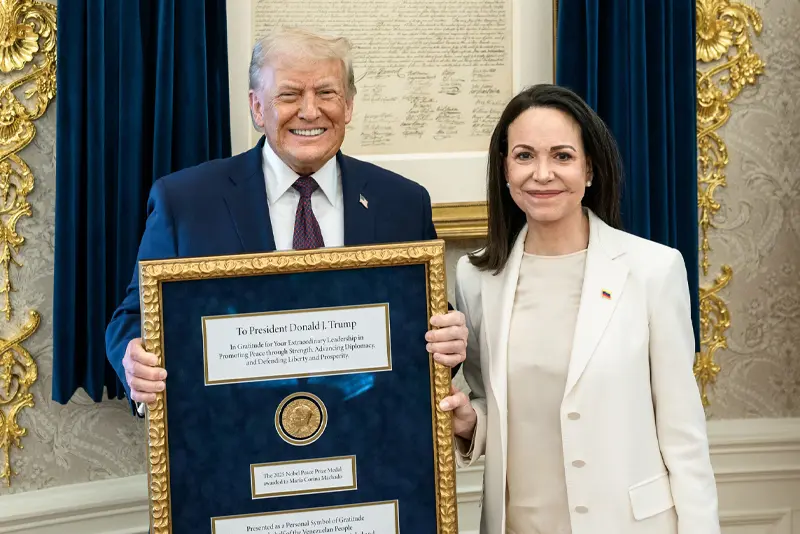
WASHINGTON — Venezuelan opposition leader María Corina Machado on Thursday presented President Donald Trump with her 2025 Nobel Peace Prize medal during a highly publicized meeting at the White House — a symbolic gesture that has captured international attention and raised complex questions about U.S.–Venezuela policy and the role of symbolism in global diplomacy. According to ABC News, Machado’s visit was intended to publicly acknowledge Trump’s role in recent Venezuelan political developments.
Historic Gesture, Limited Legal Standing
In the Oval Office, Machado handed Trump the gold Nobel Peace Prize medal she earned in 2025 for her leadership in Venezuela’s democratic movement. A White House photo release showed the medal displayed in a frame inscribed with a tribute to Trump’s “extraordinary leadership in promoting peace through strength” and his role in advancing freedom in Venezuela.
Trump publicly acknowledged the medal, calling it “a wonderful gesture of mutual respect” in a Truth Social post. Machado described the presentation as a sign of gratitude from the Venezuelan people for Trump’s role in recent developments. However, the Norwegian Nobel Committee has clarified that a Nobel Peace Prize cannot legally be transferred or shared, and the title remains exclusively with the original recipient.
Context: Venezuela and U.S. Policy Shifts
Machado’s visit comes after a dramatic political shift in Venezuela, including a U.S.-supported operation that resulted in the capture of former Venezuelan President Nicolás Maduro. Machado publicly credited Trump for his decisive action in removing Maduro, calling it a historic milestone for Venezuelan freedom.
Despite Machado’s praise, the White House has shifted diplomatic engagement toward Delcy Rodríguez, Maduro’s former vice president, now acting president, who is the United States’ primary interlocutor in Caracas. Rodríguez has emphasized strengthening diplomatic ties with Washington while defending Venezuela’s broader global partnerships.
Trump’s administration has not provided a timeline for democratic elections in Venezuela, instead highlighting ongoing cooperation with Rodríguez’s interim government. Machado has acknowledged that her discussions with the president were largely symbolic.
Economic and Political Implications
Venezuela’s economy remains in crisis after years of hyperinflation, steep contraction, and mass emigration. According to historical economic data, the Venezuelan economy shrank by more than 75% over the past decade, with poverty affecting the majority of citizens. Recovery efforts face hurdles in attracting foreign investment and stabilizing essential services.
The U.S. is also monitoring the economic fallout. Inflation and employment sentiment in Venezuela continue to affect U.S. foreign aid decisions and humanitarian initiatives.
What Comes Next
Looking ahead, U.S.–Venezuela relations will likely balance symbolic milestones with realpolitik considerations. Trump’s acceptance of Machado’s medal underscores the administration’s desire to project strength and support democracy in the hemisphere, even as policymakers navigate legitimacy issues around Venezuela’s leadership.
The next steps hinge on whether symbolic gestures translate into tangible progress toward democratic elections, economic recovery, and long-term institutional reform. The White House has signaled ongoing interest but has not outlined concrete milestones.
Wayne Roberts is a journalist specializing in world affairs, covering international politics, global security, and major geopolitical developments.