Historic demonstrations sweep Islamic Republic as Crown Prince Reza Pahlavi emerges as opposition leader—and the world watches
By Wayne Roberts | January 9, 2026
WASHINGTON — In a moment that may define Iran’s future, exiled Crown Prince Reza Pahlavi issued a direct call to action Tuesday that has transformed scattered economic protests into what analysts are calling the most significant challenge to the Islamic Republic in decades.
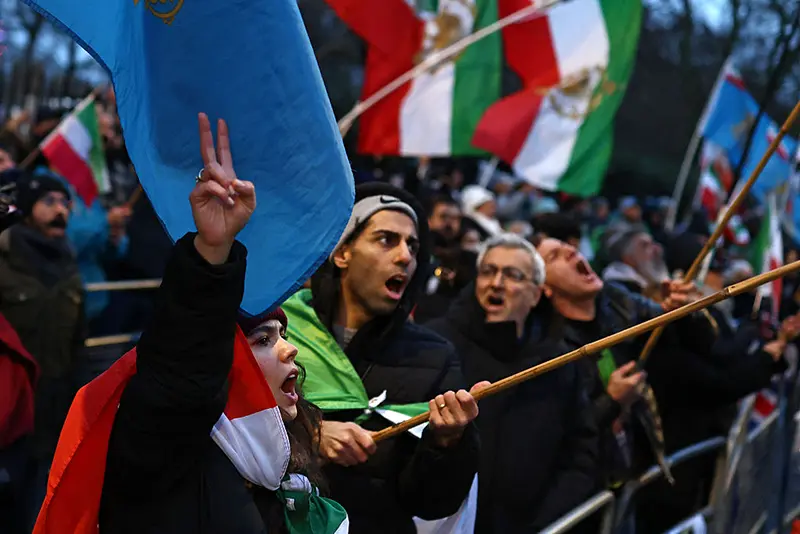
On January 8, the intensity and scale of protests increased significantly following a call from Reza Pahlavi for people to chant slogans at 8 p.m. local time. When that hour struck Thursday evening, neighborhoods across Tehran erupted. Thousands flooded the streets in dozens of cities, their voices unified in a chorus that echoed through the capital and beyond: “Death to the dictator!” and “This is the last battle! Pahlavi will return!”
The Iranian government’s response was swift and severe—cutting off internet and telephone services nationwide in an attempt to quell the protests.
A Prince’s Gamble Pays Off
Pahlavi issued his first direct call for protests with a video message in Farsi on Tuesday night across social media platforms, marking a dramatic shift in tactics for the 63-year-old son of Iran’s last shah. His father, Mohammad Reza Pahlavi, fled Iran just before the 1979 Islamic Revolution—an event that ended more than 2,500 years of Persian monarchy.
“My dear compatriots,” Pahlavi said in his video address. “Over the last week, I have watched your demonstrations closely, particularly those that are taking place in the bazaars of Tehran. Despite the regime’s ongoing violent crackdown, you are resisting, and it is inspiring.”
The results exceeded expectations. Thousands could be seen on the streets as videos circulated online showing demonstrations in at least 46 cities across 21 provinces, according to the Human Rights Activists News Agency (HRANA). The coordinated timing and scale of the response represented something unprecedented—a test of whether the Iranian public would answer a call from an opposition figure in exile.
They did.
What Makes This Different
Unlike previous protest movements in Iran, which remained largely leaderless and spontaneous, Thursday night’s demonstrations were coordinated, timed, and executed in response to a specific command from a named leader. That shift alone has fundamentally altered the political landscape.
What happened in Iran on Thursday night was not simply another protest but coordinated mass demonstrations unfolded nationwide in response to a direct call from Prince Reza Pahlavi that specified not only the action but also the timing, wrote Iran International, a Persian-language news outlet.
Previous calls for action from outside Iran have been largely ignored. This one was answered simultaneously and at scale—a political threshold that surprised supporters and skeptics alike.
The protests also differ in their openly monarchist character. While the 2022 demonstrations following Mahsa Amini’s death in police custody focused on women’s rights and social freedoms, today’s movement features explicit calls for the return of the Pahlavi dynasty. Symbols associated with the protests included the Lion and Sun flag, which was waved in several demonstrations as a sign of monarchist aspirations and opposition to the government. On Thursday, social media platform X changed Iran’s flag emoji from the Islamic Republic’s banner to the old monarchy flag in support of demonstrators.
The Economic Spark That Lit the Fire
The protests began December 28 when merchants in Tehran’s historic Grand Bazaar—the beating heart of Iran’s economy for centuries—shut their shops in protest. The immediate trigger was economic devastation that has left ordinary Iranians struggling to survive.
In the final months of 2025, Iran’s economy experienced an unprecedented surge in exchange rates, with the U.S. dollar reaching approximately 145,000 tomans, while the country’s inflation rate hit 42.2% in December 2025.
Basic necessities have become luxuries. Cooking oil prices doubled overnight. The Iranian rial has lost virtually all its value against the dollar, and years of international sanctions—reimposed after the U.S. withdrew from the nuclear deal in 2018—have strangled the economy.
Iran’s economy saw sharp rates of inflation, devalued currency, and an energy deficit, culminating in repeated electricity and gas disruptions. President Masoud Pezeshkian, elected in 2024 on promises of good governance and economic reform, has instead presided over rolling blackouts and water shortages while failing to deliver meaningful change.
The economic pain has been compounded by Iran’s geopolitical losses. The fall of Syria’s Assad regime—a key Iranian ally—represented a major blow to Tehran’s regional influence, adding to a sense of national decline.
A Deadly Crackdown
The regime’s response has been characteristically brutal. The crackdown has resulted in the killing of at least 28 protesters and bystanders, including children, in 13 cities across eight provinces between December 31, 2025 and January 3, 2026, according to Amnesty International and Human Rights Watch. Other sources, including HRANA, place the death toll as high as 42.
Security forces, including the Islamic Revolutionary Guard Corps and Iran’s police force, have unlawfully used rifles, shotguns loaded with metal pellets, water cannon, tear gas and beatings to disperse protesters. In one particularly egregious incident, security forces stormed a hospital in Ilam province to arrest injured demonstrators, using tear gas inside the medical facility.
Hundreds have been arrested. HRANA estimated that since the beginning of the protests there had been 990 arrests by January 4, with that number climbing past 2,000 in subsequent days. Many detainees have been subjected to enforced disappearance and face the risk of torture.
Supreme Leader Ayatollah Ali Khamenei has shown no signs of compromise. On January 3, as security forces killed at least 11 protesters, Khamenei declared that “rioters should be put in their place.” On Friday, he doubled down: Khamenei said in remarks that the government would “not back down” against the protesters, whom he described as “vandals”.
Trump Issues Warning
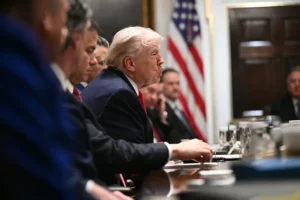
The international dimension adds another layer of complexity. President Donald Trump has repeatedly warned Tehran against killing protesters, threatening consequences if the violence continues.
“If Iran shots and violently kills peaceful protesters, which is their custom, the United States of America will come to their rescue. We are locked and loaded and ready to go,” Trump wrote on Truth Social on January 1.
On Thursday, as Pahlavi’s call mobilized millions, Trump renewed his warning: “I have let them know that if they start killing people—which they tend to do during their riots, they have lots of riots—if they do it, we’re going to hit them very hard,” the president told podcaster Hugh Hewitt.
However, Trump stopped short of endorsing Pahlavi himself. When asked if he would meet with the exiled prince, Trump demurred. “I think that we should let everybody go out there and see who emerges. I’m not sure necessarily that it would be an appropriate thing to do,” Trump said, suggesting the U.S. wants to see how events unfold before backing any particular opposition figure.
Still, protesters have embraced Trump’s support. Videos shared online show demonstrators putting up stickers naming streets after Trump, while others have chanted, “Neither Gaza nor Lebanon; my life for Iran”—a direct rejection of the regime’s foreign policy priorities.
What Happens Next?
The immediate challenge for protesters is maintaining momentum despite the nationwide communications blackout. NetBlocks, a global internet monitoring group, reported that Iran had been offline for more than 12 hours on Thursday, with connectivity at less than 1% of normal levels—making it difficult for citizens to coordinate or share information with the outside world.
Pahlavi has already called for continued action. On Friday, he urged those who were hesitant to join future demonstrations. “You saw how a massive crowd forces the repressive forces to retreat. Those of you who were hesitant, join your fellow compatriots on Friday night and make the crowd even larger so that the regime’s repressive power becomes ever weaker,” he said on social media.
The prince has also called on world leaders to help restore communications. “I urge all world leaders to utilize all available technical, financial, and diplomatic capacities to restore communications to the people of Iran so that their voices can be heard and their will can be seen,” he wrote. “Do not let the voices of my brave compatriots be silenced.”
Several Iranian Kurdish opposition parties have joined the call, issuing a joint statement urging a general strike to support the protests, particularly in Kurdish-majority provinces.
A Regime Under Pressure
The Islamic Republic faces its most serious challenge in years. The protests have spread beyond traditional opposition strongholds to include Iran’s powerful merchant class—the same group that helped bring down the monarchy in 1979. When the Grand Bazaar shuts down, the regime takes notice.
Internal divisions are becoming visible. Members of parliament have accused both the government and the public of contributing to the economic collapse, while President Pezeshkian has pointed fingers back at parliament. Notably absent from these recriminations has been any acknowledgment of Supreme Leader Khamenei’s role—a silence that speaks to the limits of internal debate.
The government has attempted some damage control. Mohammad Reza Farzin resigned as governor of the Central Bank and was replaced by Abdolnasser Hemmati, a former economics minister. But these changes feel like rearranging deck chairs on the Titanic as the economic fundamentals remain dire and sanctions show no signs of easing.
Historical Echoes
For older Iranians, the parallels to 1979 are impossible to ignore. Then, as now, economic grievances sparked protests that evolved into calls for regime change. Then, as now, the merchant class played a crucial role. Then, as now, an exiled opposition figure captured the imagination of protesters.
But there are critical differences. The 1979 revolution had Ayatollah Ruhollah Khomeini—a charismatic religious figure who offered a clear alternative vision. Today’s protesters are more fragmented in their goals, even as they unite behind Pahlavi’s leadership. Some seek democracy, others constitutional monarchy, still others simply want an end to clerical rule without agreement on what comes next.
“The lack of a viable alternative has undermined past protests in Iran. There may be a thousand Iranian dissident activists who, given a chance, could emerge as respected statesmen. But so far, the Iranian security apparatus has arrested, persecuted and exiled all of the country’s potential transformational leaders,” wrote Nate Swanson of the Washington-based Atlantic Council.
Yet something shifted Thursday night. Reza Pahlavi crossed a line that many before him failed to reach. This was not symbolism, nostalgia, or digital noise. It was a successful act of political command, as Iran International put it. Whether that command can be sustained—and whether it leads to meaningful change—remains to be seen.
The Stakes
For the Iranian people, the stakes couldn’t be higher. Decades of economic mismanagement, international isolation, and authoritarian rule have left a population—particularly younger Iranians—desperate for change. IranWire viewed Generation Z Iranians as “one of the most visible and active groups” in the protests, whose political views were strongly impacted by the Mahsa Amini protests of 2022-2023.
For the region, Iran’s instability represents both opportunity and danger. Israel and several Arab states would welcome the regime’s fall, while others fear the chaos that could follow. A nuclear-armed nation of 89 million people doesn’t transition peacefully from theocracy to something else overnight.
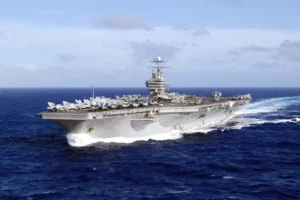
For the United States, the situation presents a dilemma. Trump’s threats create expectations of action, but meaningful intervention could escalate into a broader regional conflict—something even hawkish advisers recognize as potentially catastrophic.
As Friday evening approaches and Pahlavi calls for renewed demonstrations, one thing is certain: Iran has crossed a threshold. Whether it leads to regime change, violent suppression, or some negotiated settlement remains unknown. But the genie of organized, coordinated opposition—with a focal point in Pahlavi—is out of the bottle.
“The regime is crumbling and is very close to collapsing,” Pahlavi told Fox News’ Sean Hannity earlier this week. Supreme Leader Khamenei would disagree. The coming days and weeks will reveal which assessment is closer to the truth.
Editor’s Note: Due to the Iranian government’s communications blackout, some details of ongoing events cannot be independently verified. This article relies on credible international human rights organizations, verified video footage, and statements from official sources.
Wayne Roberts is a journalist specializing in world affairs, covering international politics, global security, and major geopolitical developments.