Cellphone footage from the agent’s perspective raises new questions about tactics and training as Secretary Noem doubles down on “domestic terrorism” label
By Maria Jones | January 12, 2026
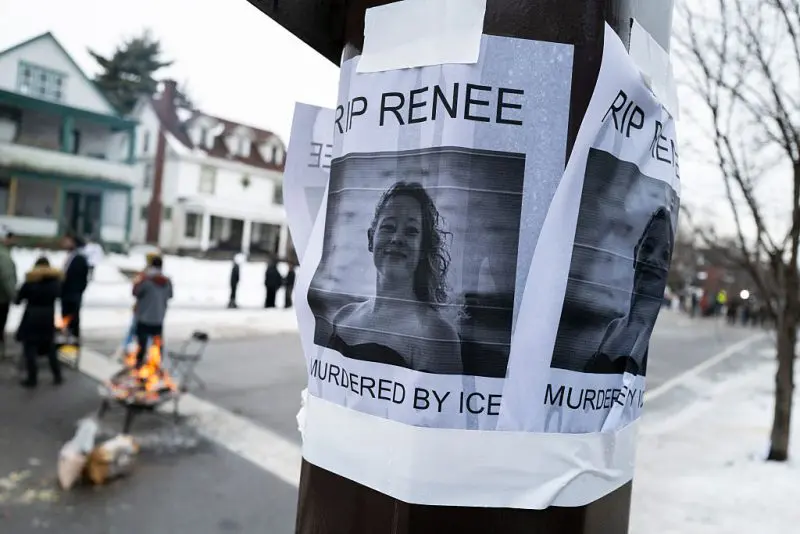
MINNEAPOLIS — A newly obtained cellphone video showing the final moments before an ICE agent fatally shot Renee Nicole Good has intensified the already explosive debate over what happened on a south Minneapolis street last Wednesday—and whether the officer’s use of deadly force was justified.
The 47-second recording, captured by Immigration and Customs Enforcement officer Jonathan Ross himself, shows him approaching Good’s burgundy Honda Pilot with his phone camera raised in one hand. Less than a minute later, with that same phone still gripping his left hand, Ross draws his service weapon with his right and fires three shots into the vehicle, killing the 37-year-old mother of three.
What makes this footage particularly striking is what it reveals about the critical seconds before the shooting. As Good sits calmly in the driver’s seat, both hands visible, she tells Ross: “That’s fine dude. I’m not mad at you.” Her wife, Becca Good, stands outside the passenger side holding her own phone toward Ross and says, “You wanna come at us? You wanna come at us? I say go get yourself some lunch, big boy.”
Then, as Good puts her vehicle in reverse and prepares to drive forward, Becca Good can be heard yelling: “Drive, baby, drive!”
Those three words have become a flashpoint in the national debate over the incident. To federal officials and Trump administration supporters, they prove Good was attempting to weaponize her vehicle against law enforcement. To critics, they demonstrate a woman trying to escape a frightening situation—not attack it.
The video has done little to resolve the fundamental disagreement. If anything, it’s made things worse.
Noem Stands Firm: “Domestic Terrorism”
Homeland Security Secretary Kristi Noem has not wavered in her characterization of the incident, despite mounting criticism from Democrats, civil liberties advocates, and even some Republicans.
In a contentious interview with CNN’s Jake Tapper on Sunday, Noem doubled down on her assessment that Good engaged in domestic terrorism, defending her decision to publicly label it as such within hours of the shooting—before any formal investigation had begun.
“Everything that I’ve said has been proven to be factual and the truth,” Noem told Tapper. “This administration wants to operate in transparency.”
When Tapper pressed her on how she could be certain of her assertions so quickly, Noem fired back: “When there is something that is weaponized to use against the public and law enforcement, that is an act of domestic terrorism. You don’t get to change the facts just because you don’t like them.”
The exchange grew heated as Tapper noted that much of the country sees the video footage and arrives at dramatically different conclusions. “We’ve all seen the video,” Tapper said repeatedly. “She is blocking the street. They approach her… That’s not what happened.”
Noem announced Sunday that hundreds of additional federal officers would be deployed to Minneapolis following the shooting—a move critics say amounts to escalation rather than de-escalation. Democrats in Congress have threatened to impeach Noem over the incident, while 159 members of Congress, led by Rep. Ilhan Omar (D-Minn.), have demanded accountability from DHS.
“This is not law enforcement. It is state violence,” Omar wrote in a statement. “It is simply indefensible, and ICE must be held accountable.”
What the Video Shows—And Doesn’t
Multiple videos of the incident have now surfaced, captured from different angles by bystanders, Good’s wife, and Ross himself. Together, they provide an unusually comprehensive view of a deadly police shooting—yet they’ve managed to convince almost no one to change their position.
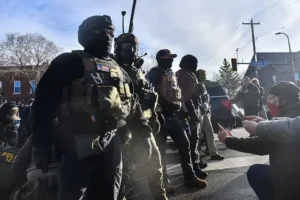
The videos show Ross and other federal agents approaching Good’s vehicle, which was stopped perpendicular across Portland Avenue in the Central neighborhood of south Minneapolis. Good had been blowing a whistle and alerting residents to ICE’s presence—a common tactic among immigration activists trying to warn vulnerable community members.
Ross’s bodycam-style footage shows him walking around the vehicle while recording with his phone. Another agent can be heard telling Good to “get out of the f****** car,” but Good remains relatively calm. She first reverses the Honda Pilot slightly, then shifts into drive and begins moving forward.
As she does, video analysis by ABC News shows Good turning her steering wheel to the right—away from where Ross is standing to the front-left of the vehicle. The metadata analysis found just 399 milliseconds passed between the first and second shots Ross fired, with 299 milliseconds between the second and third.
Ross yelled “Woah” as he drew his weapon and fired. The angle of his phone camera does not clearly capture whether the vehicle made contact with him. DHS claims Ross was “hit by the vehicle” and treated at a hospital before being released. Minneapolis Mayor Jacob Frey called that claim “garbage” and “bulls**t.”
Video from the scene shows Good’s vehicle continuing down the street after the shooting before crashing into a parked car approximately three seconds later. Good was pronounced dead from a gunshot wound to the head.
The Cellphone Question
Perhaps the most unusual aspect of Ross’s video is that it exists at all—and that he was still filming as he opened fire.
“Now that we can see he’s holding a gun in one hand and a cellphone in the other filming, I want to see the officer training that permits that,” Geoff Alpert, a criminology professor at the University of South Carolina, told NPR.
John P. Gross, a professor at the University of Wisconsin Law School who has written extensively about officers shooting at moving vehicles, went further: “If you are an officer who views this woman as a threat, you don’t have one hand on a cellphone. You don’t walk around this supposed weapon, casually filming.”
The video shows Ross continued to hold his phone with the camera app open even after the shooting, walking down the street with the device still in hand. Trump administration officials have distributed the footage widely, with Vice President JD Vance tweeting: “Watch this, as hard as it is. Many of you have been told this law enforcement officer wasn’t hit by a car, wasn’t being harassed, and murdered an innocent woman.”
But policing experts say the footage raises as many questions as it answers about Ross’s tactical decisions. If Good posed an imminent deadly threat, why was Ross casually filming her? If the situation was so dangerous, why did he walk directly in front of her vehicle rather than taking cover or creating distance?
“The video demonstrates that the officers didn’t perceive Good to be a threat,” Gross told NPR, noting that Ross’s body language and positioning contradict claims of imminent danger.
An Agent with a Violent History
The shooting has brought renewed attention to Ross’s background and previous encounters with suspects. Federal officials initially refused to identify the shooter, citing safety concerns, but multiple media outlets confirmed his identity through court records.
Jonathan Ross, 43, is an Iraq War veteran who served with the Indiana National Guard from 2004 to 2005. He joined the Border Patrol in 2007, working near El Paso, Texas, as a field intelligence agent analyzing cartel and smuggling operations. In 2015, he transferred to ICE, where he has worked in fugitive operations targeting what he described in court testimony as “higher value targets.”
Ross is also a firearms instructor, active shooter instructor, and member of ICE’s Special Response Team—an elite unit that requires a 30-hour tryout and specialized training in tactics like breaching, hostage rescue, and advanced marksmanship.
But Ross’s career has been marked by violence. Just six months before shooting Good, he was involved in another incident that left him seriously injured.
In June 2025, Ross and other ICE agents attempted to arrest Roberto Carlos Muñoz-Guatemala during a traffic stop in Minneapolis. Muñoz-Guatemala, who was in the country illegally and had been convicted of sexually abusing a teenage relative, refused to comply. According to court documents, Ross broke the suspect’s car window and reached inside to unlock the door, but his arm became stuck.
When Muñoz-Guatemala attempted to drive away, Ross was dragged approximately 50 to 100 yards across the pavement. The incident was captured on video. Ross suffered multiple large cuts and abrasions to his knee, elbow, and face, requiring 33 stitches. An FBI agent applied a tourniquet before Ross was transported to a hospital.
Muñoz-Guatemala was later convicted, with a jury finding he “should reasonably have known that Jonathan Ross was a law enforcement officer and not a private citizen attempting to assault him.”
Both Noem and Vice President JD Vance have referenced the June incident repeatedly when defending Ross’s actions in the Good shooting. “That very ICE officer nearly had his life ended six months ago,” Vance said at a White House press conference Thursday. “You think maybe he’s a little bit sensitive about somebody ramming him?”
The question of whether Ross’s previous trauma influenced his decision to use deadly force against Good has become central to the debate. Critics argue that an officer who suffered such a violent encounter should not have been placed in situations likely to trigger similar responses. Supporters say Ross’s experience made him appropriately cautious when faced with what they view as a similar threat.
Minnesota Officials Push Back
The contrast between federal and local officials’ accounts of the shooting could hardly be starker.
Minneapolis Mayor Jacob Frey has been blunt in his assessment: “They are already trying to spin this as an action of self-defense. Having seen the video myself, I wanna tell everybody directly, that is bulls**t. To ICE, get the fuck out of Minneapolis.”
Minnesota Governor Tim Walz proclaimed January 9 “Renee Good Day” in honor of the victim. He has repeatedly warned that residents won’t trust any federal investigation after President Trump, Vice President Vance, and Secretary Noem all publicly weighed in before the facts were established.
On Thursday, Drew Evans, head of the Minnesota Bureau of Criminal Apprehension, revealed that the FBI had revoked the state’s access to evidence in the case, reversing an earlier agreement for a joint investigation. “It would be extremely difficult, if not impossible” for a state-level investigation to continue “without cooperation from the federal government,” said Minnesota’s Public Safety Commissioner.
Minneapolis County Prosecutor Mary Moriarty and Minnesota Attorney General Keith Ellison have called on residents to submit videos, photos, and eyewitness accounts directly to state investigators. Ellison called Noem’s use of the “domestic terrorism” label “an abuse of the term.”
President Trump has defended the decision to exclude state officials, calling them “crooked” and describing Walz as “an incompetent governor” and “a stupid person.”
The shooting occurred approximately one mile from where George Floyd was murdered by Minneapolis police officer Derek Chauvin in 2020—a fact not lost on residents who remember the protests and national reckoning that followed.
Who Was Renee Good?
Lost in the political firestorm is the woman at the center of it all.
Renee Nicole Macklin Good was a 37-year-old poet, writer, and mother of three. Originally from Colorado Springs, she had lived in multiple states before settling in Minneapolis with her wife Becca and their 6-year-old son. She had two other children from previous marriages.
Good graduated from Old Dominion University with an English degree. Her second husband, a military veteran, died in 2023 at age 36. According to a neighbor, Good had briefly moved to Canada following Trump’s 2024 election victory before returning to Minneapolis.
Her ex-husband told the Associated Press that Good wasn’t an activist and he hadn’t known her to participate in protests. On the morning of January 7, she had dropped off her son at school and was driving home when she encountered ICE agents conducting operations in her neighborhood.
“On Wednesday, January 7th, we stopped to support our neighbors. We had whistles. They had guns,” Becca Good wrote in a statement. “I am now left to raise our son and to continue teaching him, as Renee believed, that there are people building a better world for him. That the people who did this had fear and anger in their hearts, and we need to show them a better way.”
An online fundraiser for Good’s family closed after raising more than $1.5 million in donations, which will be placed in a trust fund for her children.
A City on Edge
The shooting has plunged Minneapolis into crisis. Minneapolis Public Schools canceled classes for the remainder of the week following the incident, citing safety concerns after ICE agents used pepper spray and pepper balls against students at Roosevelt High School. Two staff members were handcuffed by armed ICE officers at the school. MPS has offered remote learning options through February 12.
Protests have erupted nightly since the shooting. On Friday night, hundreds of demonstrators gathered outside downtown Minneapolis hotels where federal agents are believed to be staying, banging drums, blowing whistles, shining lights into windows, and chanting “Abolish ICE” and “Justice for Renee Good.”
“The goal seems to be that no one at this hotel can sleep, with the target, in that case, being federal agents,” CNN correspondent Omar Jimenez reported from the scene. Minnesota State Patrol officers in riot gear eventually declared an unlawful assembly and made arrests, with the state Department of Public Safety saying demonstrations were “no longer peaceful” and there was “damage to property.”
The shooting has also sparked protests in multiple other cities, including Chicago, New York, Washington D.C., Buffalo, Durham, Chapel Hill, Kansas City, and Los Angeles. Over 1,000 protests were planned for the weekend following the shooting, with tens of thousands marching in Minneapolis alone.
The Broader Context
Good’s death is part of a larger pattern. According to multiple reports, her killing marked the ninth time ICE agents had opened fire on people since September 2025. Four other people have been killed during federal deportation operations in recent months.
The shooting came just one day after the Department of Homeland Security announced what it called the “largest immigration enforcement operation ever,” deploying more than 2,000 agents to the Minneapolis-St. Paul metropolitan area. The surge followed viral videos—later criticized as misleading—targeting Somali Americans and alleging widespread welfare fraud.
Eyewitnesses told reporters that “people in our neighborhood have been terrorized by ICE for six weeks” before Good’s death.
Just one day after Good was killed, Border Patrol agents shot and wounded two people in Portland, Oregon, in a separate incident that also sparked protests and investigations.
The aggressive immigration enforcement tactics have drawn comparisons to other contentious episodes in recent immigration policy, but with a key difference: previous administrations, even when pursuing tough enforcement, generally avoided large-scale, visible operations in major urban centers. The Trump administration has explicitly embraced what Reuters describes as “showy sweeps” over targeted arrests—a strategy designed to maximize public visibility and send a message about enforcement priorities.
What Happens Next?
The FBI is investigating the shooting, though Minnesota officials have been effectively shut out of the process. No charges have been filed, and it remains unclear whether Ross will face any discipline or accountability.
Noem has made clear that ICE operations in Minneapolis will not only continue but expand. “We’re sending more officers today and tomorrow; they’ll arrive, there’ll be hundreds more,” she announced Sunday.
Legal experts say the case raises profound questions about the use of deadly force by federal agents, particularly in situations where the immediate threat is unclear. The fact that Ross was filming with one hand while shooting with the other, they argue, suggests his own assessment of danger was ambiguous at best.
“Essentially within hours of the incident occurring, labelling this activity as domestic terrorism, what that does is effectively strip domestic terrorism of its significance,” said one expert who studies law enforcement use of force. “Now what is domestic terrorism? Whatever the DHS secretary says it is?”
For Minneapolis, the shooting has reopened wounds that never fully healed from George Floyd’s murder less than five years ago. The city finds itself once again at the center of a national debate about the use of force, accountability, and the relationship between law enforcement and the communities they’re supposed to serve.
And for Good’s family, none of the political debates or video analysis will bring her back.
“Kindness radiated out of her,” Becca Good told Minnesota Public Radio. Now she’s left to raise their son alone, teaching him—as Renee believed—that “there are people building a better world for him.”
Whether that’s still true remains to be seen.
Editor’s Note: This article includes descriptions of violence and death. The FBI investigation into this incident is ongoing. The cellphone video referenced in this article has been obtained and verified by multiple news organizations including Alpha News, The Washington Post, CNN, ABC News, and NBC News.
Maria Jones is a writer for U.S. politics, elections, public policy, and the cultural debates shaping American governance.